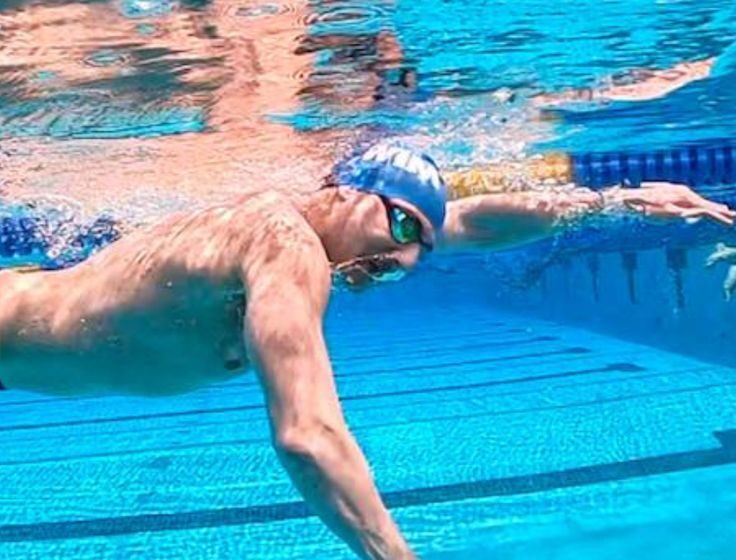

In a world that screams for our attention, where every notification is a siren and every headline a demand, the search for stillness has become an urgent quest. We pursue it in silent retreats, through ancient yogic postures, or in the hushed intensity of a meditation cushion. Yet, for many, the very act of sitting still feels like an impossible feat, a battle against the incessant hum of the modern mind. We are a species built for motion, our ancestors’ survival dependent on their ability to move, adapt, and respond. It is perhaps no wonder, then, that for a growing number, the path to inner peace is not found in stillness, but in the rhythmic, immersive dance of moving meditation.
And among the pantheon of dynamic practices – the runner’s trance, the dancer’s flow, the hiker’s quiet communion with nature – there exists one form that stands apart, a liquid sanctuary where the physical and the metaphysical converge in unparalleled harmony: swimming. It is here, suspended between worlds, that the chaotic symphony of daily life fades into a muted hum, and the mind, untethered from terrestrial gravity, finds its truest freedom. Swimming, in its purest essence, is not merely exercise; it is the ultimate form of moving meditation, a journey of "Laps of Logic" that untangles the mind, rejuvenates the spirit, and reconnects us to a primal wellspring of being.
To understand why swimming holds this unique distinction, we must first dive into the experience itself, dissecting its layers of sensory engagement, physical demand, and psychological transformation.
The Water’s Embrace: A Sensory Deprivation Chamber of the Soul
The moment you step into the water, a fundamental shift occurs. The air, with its myriad sounds, smells, and visual distractions, recedes. Your body, accustomed to the insistent pull of gravity, suddenly feels lighter, almost ethereal. This initial sensation is the prelude to an extraordinary sensory transformation.
As your head submerges, the world outside becomes muffled. The cacophony of the pool deck – the splashing, the chatter, the distant hum of machinery – softens into an indistinct murmur. It’s a gentle, yet profound, act of sensory deprivation. Unlike a meditation room, where silence is actively sought and often elusive, in the water, silence is a given, a gift bestowed by the very medium. This auditory cocoon is the first crucial step in turning the gaze inward. Without the constant bombardment of external noise, the internal dialogue, though initially loud, gradually begins to clarify.
Visually, the experience is equally transformative. Whether in the crystalline blue of a chlorinated lane or the murky depths of open water, the visual field is simplified. The sharp edges of reality blur, light refracts differently, and the world takes on an ethereal quality. There are no screens, no flashing advertisements, no endless feeds vying for your attention. Your gaze is focused on the tiled line below, the fleeting bubbles, or the shifting patterns of light on the water’s surface. This visual reduction eliminates a primary source of cognitive overload, allowing the eyes to rest and the mind to cease its relentless processing of visual information.
Then there is the tactile sensation. Water, an element both powerful and yielding, envelops the skin with a consistent, cool embrace. It is a constant, gentle pressure that acts as a full-body anchor, grounding you in the present moment. Every stroke, every glide, is a continuous interaction with this fluid medium. The water resists, yet it supports. It caresses, yet it demands. This incessant tactile feedback keeps the mind tethered to the body, making it difficult for thoughts to completely detach and spiral into anxious reverie. It’s a perpetual reminder of your physical existence, forcing a deep connection between mind and muscle.
This unique combination of sensory muffling, visual simplification, and full-body tactile engagement creates an environment unlike any other. It’s a personal, moving sensory deprivation chamber, expertly crafted by nature itself, providing the ideal conditions for the mind to finally quiet its external chatter and tune into its internal frequencies.
The Rhythmic Ritual: Breath, Stroke, and the Unfolding Present
Once submerged, the act of swimming becomes a finely tuned orchestra of breath and movement, a repetitive ritual that forms the very core of its meditative power.
The Breath: In swimming, breath is not merely an automatic function; it is a conscious, deliberate act, intimately synchronized with movement. Unlike land-based activities where breathing can often be shallow or unconscious, swimming demands a rhythmic, powerful exhalation into the water, followed by a quick, purposeful inhalation. This forced awareness of the breath is perhaps the most potent meditative anchor. Each breath becomes a mini-cycle of release and replenishment, a conscious engagement with the very essence of life.
The rhythm of breathing dictates the rhythm of the stroke, and vice-versa. It’s a reciprocal dance. A smooth, controlled breath leads to a smooth, controlled stroke. A ragged breath disrupts the flow, creating resistance. This immediate feedback loop forces absolute presence. There is no room for mental time travel – no replaying past mistakes, no rehearsing future anxieties. The only moment that matters is the current one: the turn of the head, the expulsion of air, the intake of oxygen, the extension of the arm. This continuous, mindful engagement with the breath acts as a powerful antidote to a wandering mind, drawing it back, again and again, to the unfolding present.
The Stroke: The repetitive nature of swimming strokes – freestyle, breaststroke, backstroke, butterfly – is the physical manifestation of a mantra. Each arm pull, each leg kick, is a repetition, a rhythmic pattern that the body learns to execute with increasing fluidity and grace. This repetition is not mindless; it is deeply mindful. The swimmer becomes acutely aware of the nuances of their technique: the angle of entry, the catch of the water, the power of the pull, the efficiency of the kick.
The focus shifts from "doing" to "being." The body becomes an instrument of precision, and the mind, rather than creating noise, becomes a finely tuned observer, making subtle adjustments, seeking optimal efficiency and grace. This deep somatic awareness, this intimate dialogue between mind and muscle, is what elevates swimming from mere exercise to a profound moving meditation. The body is fully engaged, fully present, and in doing so, it carries the mind along for the ride, into a state of focused absorption.
Beyond the Physical: The Mental Landscape of Laps of Logic
It is in the crucible of this rhythmic, immersive experience that the true magic of "Laps of Logic" unfolds. The paradox of swimming as meditation lies in its ability to simultaneously demand physical exertion and foster profound mental clarity.
Mindfulness in Motion: While the body is busy with its intricate choreography, the mind, freed from external distractions and grounded by breath and movement, enters a unique state. It’s not the empty mind of advanced seated meditation, but rather a mind that is actively engaged, yet unburdened. This is mindfulness in its most dynamic form. Thoughts still arise, of course, but their nature changes. They lose their sharp edges, their insistent demands. They become like fish swimming past in the water – observed, acknowledged, but not clung to.
The repetitive nature of the laps provides a framework, a container for these thoughts. One might enter the water with a tangled problem, a knot of stress, or a creative block. As the laps unfold, the mind, operating in this altered state, begins to process, to sort, to organize. The rhythmic motion seems to lubricate the gears of thought, allowing connections to form that were previously obscured.
Problem-Solving and Clarity: This is where the "Laps of Logic" truly manifests. Many swimmers report that some of their clearest insights, their most elegant solutions, or their most profound creative breakthroughs occur in the pool. The brain, operating at a lower level of external stimulation, yet stimulated by physical activity and increased blood flow, seems to enter a kind of "default mode network" on steroids. Without the pressure to think about a solution, the solution often simply emerges.
It’s as if the water, by stripping away the noise, allows the subconscious mind to present its wisdom. A work dilemma that seemed insurmountable on land suddenly untangles itself in a neat sequence of steps. A creative block dissolves, replaced by a flood of ideas. An emotional conflict finds resolution in a moment of quiet understanding. The repetitive motion acts like a mental palate cleanser, clearing away the clutter and revealing the underlying structure of thought. Each lap is a cycle of processing, a quiet deliberation, a step closer to insight.
Emotional Release and Resilience: The water also serves as a powerful medium for emotional processing. The physical exertion releases endorphins, natural mood elevators. But beyond the biochemical, there’s a deeply cathartic quality to being enveloped by water. Tears, if they come, blend seamlessly with the element. Frustration, anxiety, even grief, can be expressed and dissolved into the vastness of the pool or the open sea. The act of pushing through physical discomfort, of maintaining rhythm despite fatigue, builds mental resilience that extends far beyond the water’s edge. It teaches patience, perseverance, and the profound satisfaction of overcoming self-imposed limits.
Self-Reflection and Introspection: Finally, the solitude of swimming fosters deep introspection. Even in a crowded lane, you are essentially alone with your thoughts, your breath, and your body. This uninterrupted internal space allows for honest self-reflection. You might reflect on your values, your goals, your relationships. You might confront fears or embrace aspirations. The quiet, rhythmic environment is conducive to profound internal dialogue, helping to integrate experiences, clarify intentions, and cultivate a deeper sense of self-awareness.
The Primal Connection: Water and Humanity
The profound impact of swimming also taps into something ancient and fundamental within the human psyche. Water is the primordial soup from which life emerged. We are born from water, spend our earliest existence suspended in amniotic fluid, and our bodies are composed predominantly of water. There is an innate, almost genetic, connection to this element.
Throughout history and across cultures, water has been a powerful symbol: of cleansing, rebirth, renewal, fluidity, and transformation. To enter the water is, in some sense, to return to origins, to reconnect with a universal source of life and peace. This primal resonance adds another layer of depth to swimming as meditation, transforming it from a mere physical activity into a spiritual journey, a ritual of purification and renewal that speaks to the deepest parts of our being. It’s a return to a state of oceanic oneness, a brief but profound escape from the fragmented self into a more holistic experience.
The Uniqueness of Swimming: Why "Ultimate"?
While many activities can be meditative – running, walking, cycling, yoga – swimming possesses a unique combination of attributes that arguably elevate it to the "ultimate" form of moving meditation.