
The sun dips below the horizon, casting long shadows across the ancient village. A shepherd, weathered by sun and wind, guides his small flock of goats back to their enclosure. Nearby, a dairy farmer, robust and steady, coaxes his herd of cows into the milking parlor. Two scenes, separated by geography, culture, and perhaps millennia, yet united by a common thread: the provision of milk, a cornerstone of human nutrition since the dawn of agriculture.
In our modern world, far removed from the rustic simplicity of these scenes, the choice of milk has become a subject of intense scrutiny, fueled by a collective desire for optimal health and well-being. We pore over nutritional labels, dissect scientific studies, and seek out the "best" options to nourish our bodies. Among the many questions that arise, a particularly intriguing one frequently surfaces: When it comes to building stronger bones and managing caloric intake, does goat milk offer a discernible advantage over its ubiquitous bovine counterpart?
This isn’t merely a question of taste or tradition; it’s a dive into the intricate biochemistry of two remarkably similar yet subtly distinct food sources. For the knowledgeable consumer, the answer lies not in a simple "yes" or "no," but in a nuanced understanding of their micronutrient profiles, the delicate dance of minerals and vitamins that dictate their true nutritional power. Let us embark on a journey of comparison, dissecting the very essence of these two milks, to uncover the story they tell about our bones and our waistlines.
The Architect’s Blueprint: Understanding Bone Health
Before we can compare the building blocks, we must first understand the structure itself. Our bones are not inert scaffolding; they are living, dynamic tissues constantly undergoing remodeling – a process of breakdown and renewal. This intricate ballet is orchestrated by a symphony of nutrients, each playing a vital role.
The undisputed superstar of bone health is Calcium (Ca). It provides the structural integrity, forming the mineral matrix that makes bones hard and strong. But calcium is not a solo performer. It requires a dedicated supporting cast. Phosphorus (P) works hand-in-hand with calcium, forming calcium phosphate, the primary mineral component of bone. The ideal ratio of calcium to phosphorus is crucial for optimal absorption and utilization.
Beyond these titans, Magnesium (Mg) often remains in the shadows, yet its contribution is profound. Over half of the body’s magnesium resides in the bones, influencing bone crystal formation and activating enzymes that regulate calcium and vitamin D levels. Potassium (K) plays a role in maintaining acid-base balance, which can indirectly impact bone mineral density by preventing calcium leaching from bones.
Then there are the trace minerals: Zinc (Zn), essential for collagen synthesis and bone mineralization; Manganese (Mn), a cofactor for enzymes involved in cartilage and bone formation; and Copper (Cu), crucial for the cross-linking of collagen and elastin, providing flexibility and strength.
And, of course, the vitamins. Vitamin D is indispensable, acting as a hormone to regulate calcium and phosphate absorption in the gut. Without adequate vitamin D, even a calcium-rich diet can fall short. Vitamin K2 (menaquinone), a lesser-known but increasingly recognized hero, directs calcium to where it’s needed – the bones and teeth – and away from where it’s not – the arteries and soft tissues. Finally, Vitamin A is important for the function of osteoblasts (bone-building cells) and osteoclasts (bone-resorbing cells), ensuring proper bone remodeling.
This comprehensive list forms our lens. With this blueprint in mind, we can now embark on our comparative analysis, examining how goat and cow milk stack up against these critical requirements.
The Calorie Conundrum: A First Glimpse at the Numbers
The phrase "fewer calories" often sits front and center in health discussions. For those meticulously tracking their energy intake, even small differences can accumulate. So, let’s address this directly.
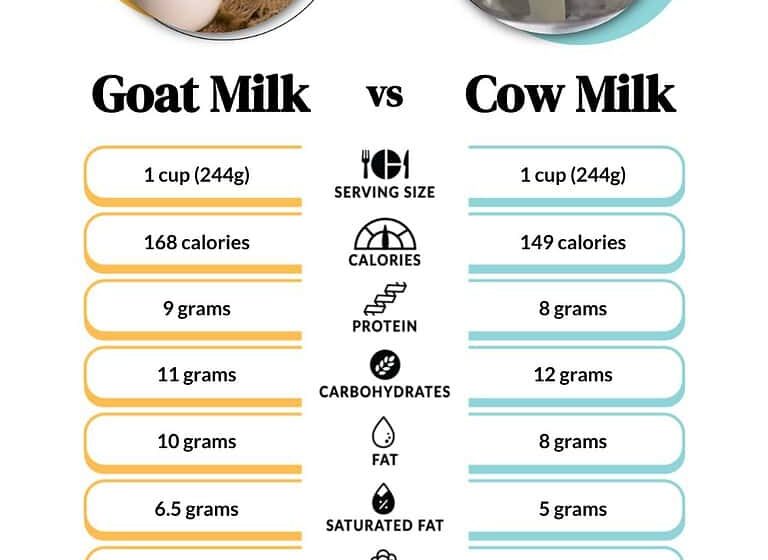
When comparing whole milk varieties, the caloric difference between goat and cow milk is often negligible, sometimes even slightly favoring cow milk, or vice-versa, depending on the specific breed, fat content, and processing. Typically, 100 milliliters (approximately 3.4 fluid ounces) of whole cow milk contains around 60-65 kilocalories, while the same amount of whole goat milk often hovers around 65-70 kilocalories.
This slight variation primarily stems from differences in fat content. Goat milk tends to have a slightly higher fat content than cow milk, averaging around 3.8-4.5 grams per 100ml compared to cow milk’s 3.5-3.9 grams. While fat is calorie-dense (9 kcal/g), it’s also crucial for nutrient absorption, especially for fat-soluble vitamins. So, a slightly higher caloric count due to fat isn’t inherently "bad," but it’s a point of distinction for those strictly focused on calorie reduction.
Lactose, the primary sugar in milk, also contributes to calories. Goat milk generally contains slightly less lactose than cow milk (around 4.0-4.5g per 100ml vs. 4.5-5.0g in cow milk), which could contribute to a minor caloric reduction, but this is usually offset by the slightly higher fat content.
Therefore, the story of "fewer calories" isn’t a dramatic one in this comparison. Both milks are relatively energy-dense due to their nutrient richness. The real story, for our knowledgeable audience, unfolds in the micronutrient landscape, where subtle differences can have profound physiological impacts.
Micronutrient Deep Dive: The Mineral Matrix
Now, let’s peel back the layers and examine the mineral contributions of each milk to our bone health.
Calcium and Phosphorus: The Dynamic Duo
As the primary architects of bone structure, calcium and phosphorus deserve our initial focus.
- Cow Milk: Typically contains slightly higher amounts of calcium, often around 110-120 mg per 100ml. Phosphorus levels are also robust, generally ranging from 90-100 mg per 100ml. The calcium-to-phosphorus ratio in cow milk is often cited as being close to the optimal 1:1 or 1.2:1 ratio, which is crucial for efficient absorption and utilization.
- Goat Milk: While numerically, goat milk might contain marginally less calcium (around 100-110 mg per 100ml), its phosphorus content is often comparable, ranging from 90-100 mg per 100ml. This still yields a very favorable calcium-to-phosphorus ratio, indicating good potential for bone mineralization.
However, the story here isn’t just about raw numbers. For the knowledgeable consumer, bioavailability is paramount. Some studies suggest that the calcium in goat milk may be more readily absorbed and utilized by the body. This enhanced bioavailability is attributed to several factors, including the unique protein and fat structures in goat milk, which we will explore later. If the body can absorb more of a slightly lower amount, the effective intake could be similar or even superior. This nuanced point challenges the simplistic view of "more is always better."
Magnesium: The Silent Contributor
Magnesium, often overshadowed by calcium, is a crucial player in bone health, influencing bone mineral density and activating hundreds of enzymes, including those involved in calcium metabolism.
- Cow Milk: Provides a respectable amount of magnesium, typically around 10-12 mg per 100ml.